
Election Campaign Helicopter Service: Fast and Efficient Air Travel for Political Campaigns
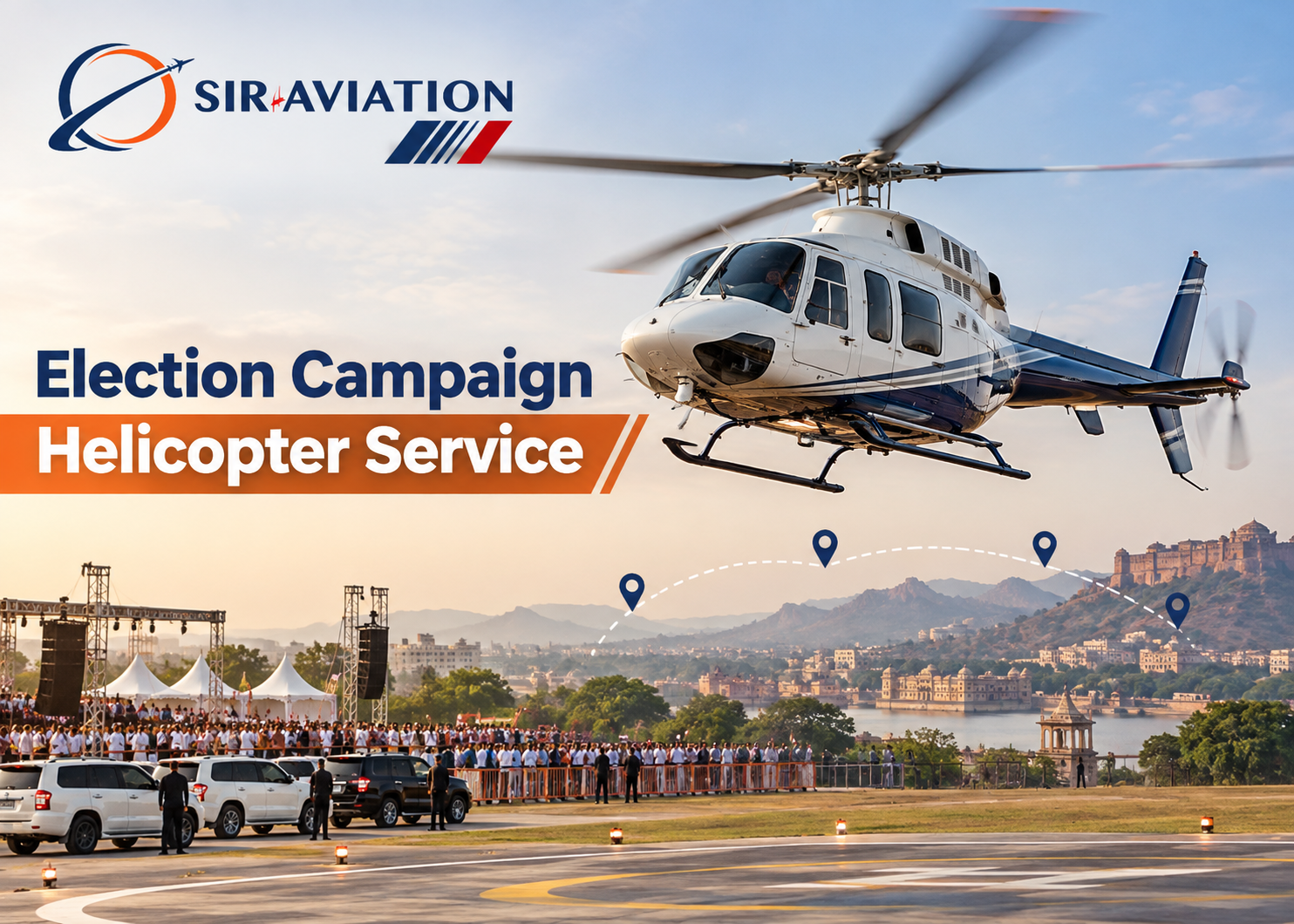
Election campaigns often require leaders, candidates, campaign teams, and authorised representatives to travel between several locations within tight schedules. An election campaign helicopter service can support such movement by reducing travel time between constituencies, rally venues, regional centres, and locations that may take several hours to reach by road.
Helicopter charter operations for election-related travel, however, involve much more than arranging an aircraft. Flight planning, landing permissions, passenger manifests, regulatory compliance, weather conditions, security coordination, helipad suitability, aviation safety, and election expenditure requirements can all affect the operation.
What Is an Election Campaign Helicopter Service?
An election campaign helicopter service is a charter aviation arrangement used for authorised political campaign travel.
Depending on the campaign itinerary, helicopters may transport:
- Political leaders
- Candidates
- Star campaigners
- Authorised party representatives
- Campaign coordinators
- Permitted accompanying personnel
The aircraft can operate between airports, approved heliports, or suitable temporary landing locations subject to applicable aviation, security, local administration, and election requirements.
Private aircraft and helicopters may be hired by political functionaries for political campaigning and election-related activities, subject to the applicable rules and procedures. Election Commission instructions also require records relating to such movements and expenditure.
Why Are Helicopters Used During Election Campaigns?
Political campaigns can involve multiple public meetings and events spread across large geographical areas. Road travel may consume a significant part of the available campaign schedule.
Helicopters can help campaign teams manage these geographical challenges more efficiently.
Faster Travel Between Campaign Locations
One of the main advantages of helicopter travel is point-to-point journey efficiency.
A political leader may need to attend events in different districts or constituencies within the same day. Where suitable landing facilities and permissions are available, helicopter travel can substantially reduce ground travel requirements.
Access to Locations Away From Major Airports
Many election rallies take place outside metropolitan areas or near towns that do not have commercial airports.
Helicopters may provide greater operational flexibility because they can potentially use authorised heliports or suitable approved landing locations closer to the campaign venue.
However, every proposed landing site must satisfy the applicable operational, safety, security, and administrative requirements.
Better Campaign Schedule Management
Campaign programmes frequently operate according to tightly controlled timelines.
A helicopter itinerary can help organisers coordinate:
- Rally timings
- Public meetings
- Regional campaign events
- Candidate appearances
- Transfers between districts
- Airport connections
- Overnight positioning
Flight schedules still remain dependent on operational feasibility, weather, airspace restrictions, regulatory approvals, daylight limitations where applicable, and local conditions.
How Does Election Campaign Helicopter Booking Work?
Booking normally starts with a detailed assessment of the proposed travel programme.
The charter coordinator or aviation operator may require information such as:
- Travel date
- Departure point
- Destination
- Number of passengers
- Approximate passenger weights
- Proposed departure time
- Rally or meeting schedule
- Landing-site information
- Return itinerary
- Number of sectors
- Luggage requirements
- Security arrangements
Providing an accurate itinerary early can make operational planning considerably easier.
Choosing the Right Helicopter for Election Campaign Travel
Not every helicopter is suitable for every itinerary.
Aircraft selection depends on several operational factors rather than passenger capacity alone.
Passenger Capacity
The number of passengers travelling on each sector affects the type of helicopter required.
Campaign organisers should provide an accurate passenger list instead of estimating the number shortly before departure.
Distance Between Locations
Different helicopter types have different range, payload, fuel, and operational characteristics.
A short regional sector may require a different aircraft configuration from a long multi-sector programme.
Landing Conditions
The aircraft selected must also be suitable for the intended landing location.
Factors may include:
- Available landing area
- Surface condition
- Surrounding obstacles
- Elevation
- Weather
- Temperature
- Approach and departure paths
- Operational restrictions
The aviation operator must assess whether a proposed movement can be conducted safely.
Luggage Requirements
Helicopters have limited baggage capacity compared with many fixed-wing aircraft.
Campaign teams should therefore confirm baggage requirements in advance, particularly when passengers are carrying equipment or travelling on multi-day schedules.
Permissions for Election Campaign Helicopter Operations
Permissions are an important part of election aviation planning.
The Election Commission of India operates the Suvidha Portal, through which candidates and political parties can submit election-related permission requests electronically. Requests are routed to the relevant authorities and nodal officers for processing.
Election-related helicopter movements may require coordination among aviation authorities, election authorities, district administrations, airport or heliport operators, security agencies, and local authorities depending on the itinerary.
The exact permission process can differ according to the location and nature of the operation.
Advance Itinerary Information
Election Commission instructions state that political functionaries or political parties using helicopters or aircraft for election campaigning should provide advance information regarding the itinerary, persons travelling, and materials being carried. District authorities are also expected to maintain records relating to arrivals, departures, passengers, purpose, and landing permissions.
Campaign planners should therefore avoid treating aircraft booking and election permission procedures as separate activities.
A confirmed helicopter alone does not guarantee that every proposed sector can operate.
Passenger Manifest Requirements
Passenger details form an important part of election helicopter operations.
Election authorities may require information including:
- Number of helicopters or aircraft used
- Hiring company
- Hire charges
- Areas covered
- Number of sorties
- Passenger manifest
The Election Commission’s Observer Handbook specifically identifies these details among the information to be furnished when aircraft or helicopters are used for election campaigns.
Campaign teams should therefore maintain accurate passenger information for each sector.
Helipad Planning for Political Campaigns
Helipad planning can become one of the most important operational elements of an election campaign flight.
A suitable location must support safe landing and departure operations and meet applicable regulatory and administrative requirements.
Planning may involve evaluation of:
- Ground condition
- Dimensions of the landing area
- Obstacles
- Crowd control
- Vehicle access
- Security arrangements
- Fire and emergency arrangements
- Wind conditions
- Local permissions
- Aircraft suitability
Temporary landing-site arrangements should be coordinated well before the proposed flight whenever possible.
Weather and Operational Limitations
A helicopter offers scheduling flexibility, but aviation safety always takes priority over campaign timing.
Operations can be affected by:
- Poor visibility
- Fog
- Thunderstorms
- Heavy rain
- Strong winds
- Dust
- Low cloud
- Local weather deterioration
- Airspace restrictions
A campaign itinerary should therefore include reasonable flexibility instead of scheduling every appearance with extremely narrow margins.
The pilot and operator retain responsibility for safe aviation operations in accordance with applicable requirements.
Aviation Safety and Operator Compliance
Election-related flights remain civil aviation operations and must comply with applicable aviation regulations.
DGCA requirements place operational obligations on authorised air operators, including requirements relating to approved aircraft, operational specifications, safety, security, and flight operations.
Before arranging a charter, campaign organisers should verify relevant operating credentials and obtain proper commercial documentation.
Important areas to check can include:
- Operator authorisation
- Aircraft details
- Crew arrangements
- Insurance documentation
- Flight itinerary
- Passenger requirements
- Charter terms
- Cancellation conditions
- Operational limitations
Safety considerations should take priority over attempts to maintain an unrealistic political schedule.
Election Expenditure and Helicopter Charges
Helicopter travel during an election campaign can have implications for election expenditure accounting.
The Election Commission’s expenditure instructions provide specific rules relating to helicopter and aircraft travel, including the treatment of expenses involving candidates and designated star campaigners.
For example, the Commission’s instructions distinguish between certain travel expenditure incurred by notified star campaigners and expenditure attributable to candidates under specified circumstances.
A star campaigner who is also a candidate must account for helicopter hiring and related expenses for campaigning within that candidate’s own constituency under the applicable rules.
Because expenditure treatment depends on the circumstances of each journey, political parties and candidates should maintain proper invoices, flight records, passenger details, payment documents, and supporting records.
What Determines Election Campaign Helicopter Cost?
There is no single fixed price for every election helicopter charter.
The total cost can depend on several factors.
Helicopter Type
Larger or higher-capability helicopters generally have different operating costs from smaller aircraft.
Flying Time
Charter pricing often depends significantly on actual or billable flying time.
A programme involving several campaign locations may therefore cost more than a simple return journey.
Positioning Charges
If the helicopter must fly from its operating base to the campaign departure location before carrying passengers, positioning costs may apply.
Waiting and Detention
Long waiting periods between rallies may affect the commercial quotation depending on the operator’s terms.
Landing and Parking Charges
Airport, heliport, landing, and parking costs may also apply.
Election Commission expenditure instructions recognise actual aircraft and helicopter parking expenses when calculating relevant election expenditure.
Crew and Operational Expenses
Depending on the itinerary, charges may also reflect crew duty requirements, accommodation, transport, handling, security coordination, and overnight aircraft positioning.
Taxes and Other Charges
Applicable taxes and statutory charges can affect the final charter amount.
A written quotation should therefore clearly state what is included and excluded.
Information to Provide Before Requesting a Helicopter Quote
Providing complete trip information helps an aviation provider prepare a more realistic operational proposal.
Campaign organisers should ideally provide:
- Date of travel
- Starting location
- Every intended destination
- Number of passengers
- Passenger names when available
- Desired departure times
- Rally schedules
- Expected waiting periods
- Return destination
- Overnight requirements
- Proposed helipad details
- Contact details for local coordinators
Frequent itinerary changes can affect aircraft availability, crew duty planning, landing permissions, and charter pricing.
Multi-City Election Campaign Helicopter Planning
A multi-city political tour requires more planning than a single charter flight.
The operations team may need to coordinate:
- Aircraft positioning
- Passenger movement
- Landing permissions
- Refuelling
- Crew duty limits
- Security requirements
- Local transport
- Weather monitoring
- Ground handling
- Backup scheduling
Campaign planners should keep realistic intervals between flights and public appearances.
A delayed rally can affect the remaining sectors of the day’s flight programme.
Helicopter Service for Star Campaigners
Helicopter travel is frequently associated with star campaigners because one campaign leader may attend meetings across several constituencies.
Under Section 77-related Election Commission instructions, recognised and other eligible political parties may notify specified leaders as star campaigners within the applicable framework. Different expenditure treatment can apply to qualifying travel by such leaders.
Campaign organisations should not assume that every person described informally as a prominent campaigner automatically receives the same expenditure treatment.
Relevant records and Election Commission requirements should be checked for the election concerned.
Can Government Aircraft Be Used for Election Campaigning?
The Model Code of Conduct places restrictions on the use of official government resources for electioneering.
The Election Commission states that government transport, including official aircraft, should not be used to further the electoral interests of the party in power, subject to applicable exceptions and security provisions.
Political functionaries may instead hire private aircraft or helicopters for campaign activities in accordance with the applicable rules.
What Should Campaign Teams Check Before Confirming a Charter?
Before confirming an election flight programme, campaign coordinators should review several areas carefully:
- Operator credentials
- Aircraft availability
- Proposed helicopter type
- Passenger capacity
- Baggage limitations
- Sector timings
- Helipad feasibility
- Required permissions
- Passenger manifest procedure
- Cancellation terms
- Weather limitations
- Flight-hour calculation
- Positioning charges
- Parking or landing fees
- Tax treatment
- Invoice documentation
- Election expenditure records
A properly documented booking process can reduce operational uncertainty as campaign schedules become busier.
Why Advance Planning Matters
Helicopter availability can become constrained during major elections because several campaigns may require aircraft simultaneously.
Operational planning also becomes more complicated when multiple rallies, remote landing sites, security arrangements, and administrative approvals are involved.
Advance planning gives organisers more time to confirm aircraft availability, assess landing locations, prepare documentation, obtain permissions, coordinate local teams, and build realistic travel schedules.
However, aviation operations can still change due to safety, weather, airspace, security, or regulatory factors.
Conclusion
An election campaign helicopter service can provide efficient point-to-point transportation for authorised political campaign travel, particularly when several constituencies or rally locations must be covered within limited time. Effective planning requires much more than selecting an aircraft. Campaign teams must coordinate aviation safety, aircraft suitability, passenger manifests, landing arrangements, permissions, expenditure records, security, weather, and scheduling. A carefully planned charter programme can support campaign mobility while maintaining compliance with applicable aviation and election requirements.
Frequently Asked Questions
Can a helicopter travel directly to an election rally venue?
A helicopter may operate to a suitable authorised landing location near a rally venue if the landing site meets applicable aviation, safety, security, and administrative requirements. Not every open ground can automatically function as a helicopter landing site.
Is permission required for election campaign helicopter travel?
Yes. Applicable aviation, landing, security, local administration, and election procedures must be followed. Election-related permissions may also be processed through the Election Commission's Suvidha system where applicable.
How much does an election campaign helicopter cost?
Pricing varies according to helicopter type, flying time, positioning, itinerary, waiting requirements, landing charges, parking, operational costs, taxes, and other charter conditions.
Can several rallies be covered in one day?
Potentially, yes. Feasibility depends on distances, aircraft performance, landing-site availability, permissions, weather, flight planning, daylight or operational limitations, and crew requirements.
What passenger information is required?
Operators and relevant authorities may require passenger names and other manifest information. Election Commission instructions also require records concerning passenger manifests for election-related aircraft and helicopter movements.
Can a candidate use a helicopter for campaigning?
A candidate may use appropriately arranged private helicopter services subject to aviation and election requirements. Applicable expenditure must also be recorded according to Election Commission rules.
Are helicopter expenses counted as election expenses?
Treatment depends on who travels, the purpose of the journey, the constituency involved, and applicable provisions for candidates and designated star campaigners. Election Commission instructions contain specific rules for allocating such expenses.
Can election helicopter flights be cancelled because of weather?
Yes. Helicopter operations remain subject to weather, visibility, safety requirements, airspace conditions, and the pilot's operational assessment.
How early should campaign helicopter travel be planned?
Planning as early as practical can help with aircraft availability, helipad assessment, permissions, passenger documentation, flight scheduling, and local coordination. The final operation remains subject to applicable approvals and operational conditions.