
Aircraft for Organ Transport in India: How It Works, Benefits, Costs, Aircraft Types and Emergency Booking Process
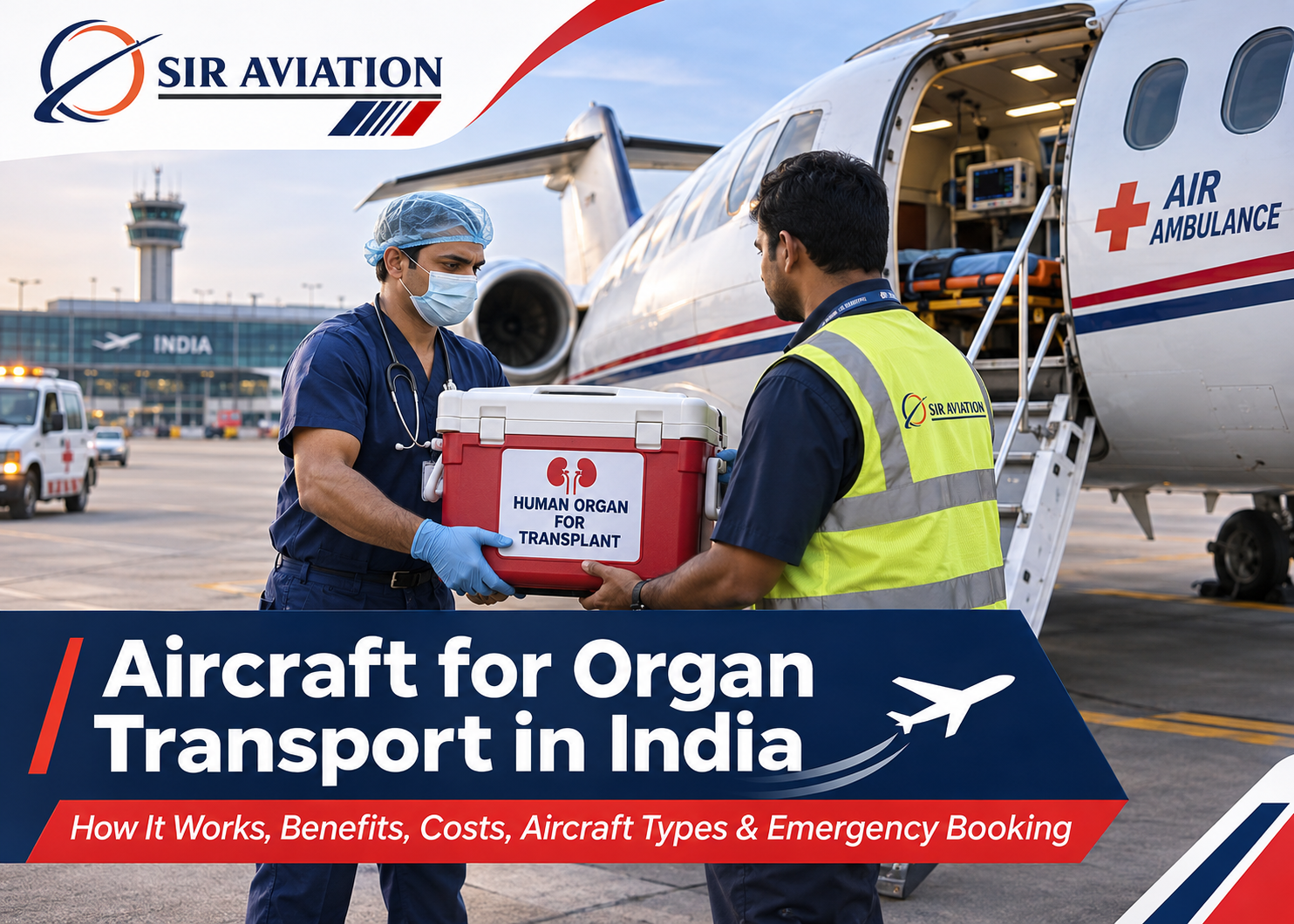
Organ transplantation demands speed, precision, and coordination between medical institutions. When a donated organ must travel between distant cities, aircraft for organ transport provide a critical transportation option that helps medical teams minimise delays. Specialised aviation arrangements connect donor hospitals with transplant centres while supporting appropriate organ preservation and secure handling. SIR Aviation helps facilitate time-sensitive aviation requirements for organ transportation across India, supporting hospitals and transplant coordinators during critical medical operations.
What Is Aircraft for Organ Transport in India?
Aircraft for organ transport are aviation services used to transfer donated human organs from retrieval hospitals to authorised transplant centres.
These services may involve chartered aircraft, private jets, turboprop aircraft, helicopters, dedicated air ambulances, or commercial passenger flights.
Unlike ordinary cargo transportation, organ transfers require strict medical supervision, specialised preservation containers, regulatory documentation, and coordination between healthcare and aviation professionals.
The objective is to reduce transportation delays while maintaining organ viability throughout the journey.
Medical teams determine the appropriate transportation method based on organ type, preservation requirements, available aircraft, distance, and the recipient’s surgical preparation.
In India, these operations must follow the applicable organ transplantation laws and established organ-transport standard operating procedures.
Why Is Air Transportation Important for Organ Transplantation?
Human organs remain suitable for transplantation for limited periods after retrieval. The available time depends on the organ, preservation method, donor characteristics, and clinical circumstances.
Delays can increase the risk of organ damage and affect transplantation outcomes.
Organ Preservation Time and Transportation Urgency
Commonly cited preservation periods for organs transported using conventional cold-storage techniques include:
- Heart: Approximately 4–6 hours.
- Lungs: Approximately 4–8 hours.
- Liver: Approximately 12–15 hours.
- Kidneys: Approximately 24–48 hours.
These figures are indicative rather than guaranteed safe limits. The transplant team establishes the acceptable timeframe for each organ.
Air transportation becomes particularly valuable when road travel cannot meet the required medical schedule.
For example, transferring a donated heart between two distant metropolitan cities may require an aircraft, coordinated airport procedures, and priority road transportation.
Careful flight planning can help medical professionals preserve valuable time for transplantation.
How Does Aircraft Organ Transportation Work in India?
Organ transportation involves multiple organisations working together under a defined medical and operational process.
1. Organ Allocation and Medical Authorisation
The process begins when an authorised medical team identifies a suitable donor organ and confirms its allocation to an eligible recipient.
The donor and recipient hospitals coordinate with the appropriate organ allocation authority.
In India, the National Organ and Tissue Transplant Organisation (NOTTO), Regional Organ and Tissue Transplant Organisations (ROTTOs), and State Organ and Tissue Transplant Organisations (SOTTOs) support the allocation framework.
Transport arrangements must follow the approved allocation decision. Booking an aircraft does not provide permission to retrieve, allocate, or transplant an organ.
2. Medical Assessment and Preservation Planning
The transplant team evaluates the organ’s condition, retrieval schedule, and preservation requirements.
Medical professionals prepare the organ using an appropriate preservation solution and approved transportation packaging.
They establish the expected preservation timeframe and identify the latest acceptable arrival schedule.
This information helps aviation coordinators assess whether a proposed flight can meet the clinical requirements.
3. Aircraft Selection and Flight Coordination
The aviation provider evaluates the departure airport, destination airport, expected flight duration, and aircraft availability.
The team also considers operational permissions, weather conditions, airport restrictions, and ground transportation arrangements.
Depending on the circumstances, a dedicated charter or a suitable commercial flight may provide the most practical solution.
4. Airport Handling and Organ Transportation
The accompanying medical professional maintains responsibility for the organ container during transportation.
Airport and airline personnel coordinate security screening, boarding procedures, aircraft handling, and priority movement where authorised.
The flight crew may request priority take-off and landing from Air Traffic Control.
Such requests remain subject to operational and safety considerations.
5. Arrival and Transfer to the Recipient Hospital
After landing, the medical team transfers the organ container to the receiving ambulance.
Where authorised, a green corridor can help reduce road delays between the airport and transplant hospital.
The receiving transplant team verifies the organ and prepares for the scheduled surgical procedure.
The entire process depends on accurate communication and carefully managed handovers.
Types of Aircraft Used for Organ Transport in India
Different aircraft offer distinct advantages depending on the transportation distance, urgency, available infrastructure, and operational conditions.
Private Charter Jets
Private jets provide a dedicated flight arrangement without dependence on scheduled passenger services.
They are particularly suitable for long-distance transfers between major cities when an appropriate aircraft can be mobilised.
Their advantages include direct routing where feasible, flexible scheduling, and space for accompanying medical personnel.
However, charter operations still require airport slots, flight permissions, and other applicable clearances.
Turboprop Aircraft
Turboprop aircraft offer an alternative for short- and medium-distance transportation.
Aircraft such as the Beechcraft King Air and Pilatus PC-12 may suit certain organ-transfer missions, depending on their availability and operating capabilities.
They can offer comparatively economical flight arrangements and access to some regional airports.
Helicopters
Helicopters may support transportation between locations where suitable landing facilities exist.
They can be particularly useful when road congestion creates substantial delays or when transfers involve regional healthcare facilities.
Helicopter operations require suitable landing sites, weather conditions, permissions, and qualified operators.
Dedicated Air Ambulances
Air ambulances can support organ transportation when the mission requires specialised medical aviation arrangements.
However, an organ-only transfer does not automatically require an aircraft equipped with intensive care facilities.
The clinical team determines the appropriate medical equipment and personnel required for the specific mission.
Commercial Passenger Aircraft
Commercial flights may provide a practical alternative when scheduled departure times match the transplantation requirements.
Under India’s organ-transport SOP, an authorised medical professional accompanies the organ container in the aircraft cabin.
Airlines may facilitate priority reservation, suitable seating, security coordination, and expedited disembarkation.
The choice depends on flight availability, medical urgency, and airline acceptance procedures.
Major Benefits of Aircraft Organ Transport Services
Faster Intercity Transfers
Aircraft can significantly reduce long-distance transportation times compared with road travel.
This advantage becomes particularly important when the recipient hospital is hundreds of kilometres away.
Better Access to Transplant Centres
Air transport connects healthcare institutions across different cities and states.
It allows authorised medical networks to consider transplantation opportunities beyond immediate geographical boundaries.
Flexible Emergency Flight Arrangements
Dedicated charters can offer greater scheduling flexibility than regular commercial flights.
This flexibility helps when medical teams cannot align an organ retrieval with a published airline schedule.
Coordinated Medical Logistics
Organ transportation involves much more than flight time.
Structured coordination between hospitals, medical escorts, aviation teams, airport authorities, and ambulance operators helps minimise avoidable delays.
Support for Time-Sensitive Transplants
Efficient transportation helps transplant specialists work within the clinically determined preservation window.
Although air travel cannot guarantee transplant success, it can provide an important logistical advantage.
How Much Does Aircraft for Organ Transport Cost in India?
The cost of aircraft organ transportation varies according to the aircraft category, flight distance, operational urgency, and associated services.
There is no single nationwide fixed charter tariff for organ transportation.
Indicative Aircraft Charter Costs
Published Indian private-charter market estimates for 2026 suggest the following approximate aircraft operating rates:
Turboprop aircraft: ₹1.25 lakh–₹2 lakh per flight hour.
Light private jets: ₹2.5 lakh–₹3.25 lakh per flight hour.
Midsize jets: ₹3.75 lakh–₹4.5 lakh per flight hour.
These are general charter market indications, not confirmed quotations for organ transport. Individual aircraft and operators may charge substantially different amounts.
The complete mission cost may also include aircraft repositioning, minimum billable hours, airport handling, applicable taxes, crew expenses, ground transportation, and medical logistics.
Factors Affecting Organ Transport Flight Costs
Flight distance: Longer routes generally increase aircraft operating expenses.
Aircraft availability: An aircraft located far from the departure airport may require additional repositioning flights.
Urgency: Short-notice mobilisation can affect aircraft selection and operational costs.
Airport operations: Landing charges, parking, handling requirements, and airport operating hours influence the final quotation.
Medical arrangements: Specialist escorts, preservation systems, and additional medical requirements may involve separate charges.
Hospitals should request an itemised quotation that identifies the complete mission cost rather than relying solely on an advertised hourly aircraft rate.
Where a suitable commercial flight meets clinical requirements, that option may cost considerably less than a dedicated charter.
Legal Requirements for Organ Transportation by Aircraft in India
Organ transportation must comply with the Transplantation of Human Organs and Tissues Act, 1994, the applicable rules, and relevant aviation regulations.
The Ministry of Health and Family Welfare introduced standard operating procedures for transporting human organs through different modes of transport in August 2024.
Essential Documentation
For air transportation, the accompanying authorised medical professional must carry applicable identity and travel documents, the specified transplantation forms, and the required hospital certification.
The air-transport SOP identifies Forms 8 and 10 under the 2014 transplantation rules and a hospital-issued certificate in the prescribed format.
The organ container must also display the required information, including organ identification, donor and recipient NOTTO IDs, hospital details, and relevant preservation information.
Safe Packaging Requirements
The organ must travel in an appropriate preservation container with leakproof primary and secondary packaging and a sufficiently strong outer covering.
The medical team must secure, seal, and label the container according to applicable requirements.
Under the SOP, the container travels with accompanying medical personnel rather than as ordinary checked baggage or an unattended cargo shipment.
The 2024 air-transport SOP specifically addresses domestic transportation within India. International organ transfers require separate legal assessment and must not be assumed permissible under domestic procedures.
What Is a Green Corridor for Organ Transportation?
A green corridor is a specially coordinated transportation route intended to minimise delays during a critical medical transfer.
Police and relevant authorities may facilitate priority movement for an ambulance carrying a donated organ.
Airport authorities can also arrange an unobstructed transfer path between the ambulance and aircraft.
How Green Corridors Support Air Transfers
A typical intercity operation may involve an ambulance moving from the donor hospital to the departure airport, an aircraft carrying the organ to the destination city, and another ambulance completing the transfer.
Coordinated movement can reduce unnecessary stoppages at critical handover points.
Green corridor arrangements depend on approvals and operational feasibility. They are not automatically guaranteed with every aircraft booking.
Emergency Aircraft Booking Process for Organ Transport in India
Emergency bookings require immediate communication between the authorised transplant coordinator and the aviation provider.
Hospitals can follow these steps when arranging an urgent flight:
- Confirm organ allocation: Obtain the required medical authorization and verify the donor and recipient hospital arrangements.
- Share transportation details: Provide the organ type, departure city, destination city, expected retrieval time, and medically acceptable arrival window.
- Check aircraft availability: Request an appropriate aircraft based on distance, urgency, and operational requirements.
- Coordinate documentation: Ensure the medical team prepares the necessary certificates, identity documents, and organ-container information.
- Arrange ground transportation: Coordinate suitable ambulances and request green corridor assistance through the authorised agencies where necessary.
- Confirm the operational schedule: Establish the planned departure, arrival, medical escort arrangements, and handover contacts before the mission begins.
What Information Should Hospitals Provide?
The aviation coordinator generally requires the departure and destination airports, the names of both hospitals, the type of organ, and the relevant medical contact details.
The coordinator also needs the expected collection time, number of accompanying personnel, and any special handling requirements.
Providing accurate information early helps reduce repeated communication and assists with operational planning.
Sensitive patient information should only be shared through appropriate authorised channels.
Challenges in Emergency Organ Transportation
Organ transportation requires planning around several unpredictable conditions.
Adverse weather can delay aircraft departure or prevent helicopter operations.
Airport restrictions, limited aircraft availability, and changing medical schedules can also affect transportation plans.
Ground traffic may create additional problems even when the flight operates on schedule.
Reliable coordination is essential because delays can occur at any stage.
Medical teams and aviation providers should establish alternative arrangements where feasible, maintain continuous communication, and escalate operational problems promptly.
A realistic transportation plan must account for the complete hospital-to-hospital journey rather than flight duration alone.
Why Choose SIR Aviation for Organ Transport Aircraft Services?
SIR Aviation provides aviation service coordination for specialised transportation requirements, including time-sensitive medical logistics.
Its organ transport service offering focuses on connecting aviation arrangements with the requirements of hospitals and transplant coordinators.
Mission-Specific Aircraft Planning
Different medical transportation requirements demand different aircraft solutions.
SIR Aviation can assess suitable charter options based on route distance, operational urgency, and the availability of aircraft.
Coordination Between Aviation and Healthcare Teams
Organ transportation requires clear communication among medical professionals, aircraft operators, and ground transportation teams.
SIR Aviation’s service approach focuses on coordinating these operational requirements to support an efficient transfer.
Support for Emergency Charter Requirements
Urgent transplantation schedules may leave limited time for arranging flights.
SIR Aviation can assist with charter enquiries, aircraft availability assessments, and applicable flight coordination.
Actual departure and arrival arrangements depend on the selected operator, regulatory permissions, weather, and airport conditions.
Focus on Transportation Efficiency
Effective organ transport requires careful attention to every movement between retrieval and delivery.
SIR Aviation aims to support hospitals through practical flight planning and coordinated aviation logistics while clinical teams retain responsibility for medical decisions and organ preservation.
Conclusion
Aircraft transportation plays an important role in connecting organ donation and transplantation facilities across India. Efficient flight arrangements, responsible medical handling, regulatory compliance, and coordinated ground transfers help hospitals manage critical transportation requirements.
SIR Aviation supports specialised aviation coordination for organ transportation, helping medical institutions assess suitable flight options when time-sensitive transfers require careful planning and dependable communication.
Frequently Asked Questions
Which aircraft are suitable for transporting human organs in India?
Private charter jets, turboprop aircraft, helicopters, dedicated air ambulances, and approved commercial passenger flights can transport human organs under applicable procedures. The best option depends on travel distance, aircraft availability, medical urgency, airport access, and preservation requirements.
What is the cost of emergency aircraft organ transport in India?
The cost depends on the aircraft, route, operational urgency, minimum billing requirements, and associated services. General charter estimates may begin around ₹1.25 lakh per flight hour for certain turboprops, but complete organ-transfer missions can cost significantly more. Hospitals should obtain a mission-specific quotation.
How quickly can a donated organ be transported by aircraft in India?
Transportation time depends on the departure and destination locations, aircraft readiness, flight duration, airport procedures, and ambulance transfers. Hearts and lungs commonly require particularly rapid transportation because of their limited preservation windows. The transplant team determines the acceptable timeframe, while the aviation provider confirms whether the proposed journey is operationally feasible.