
How to Choose the Best Air Ambulance Service in India for Emergency Patient Transfer
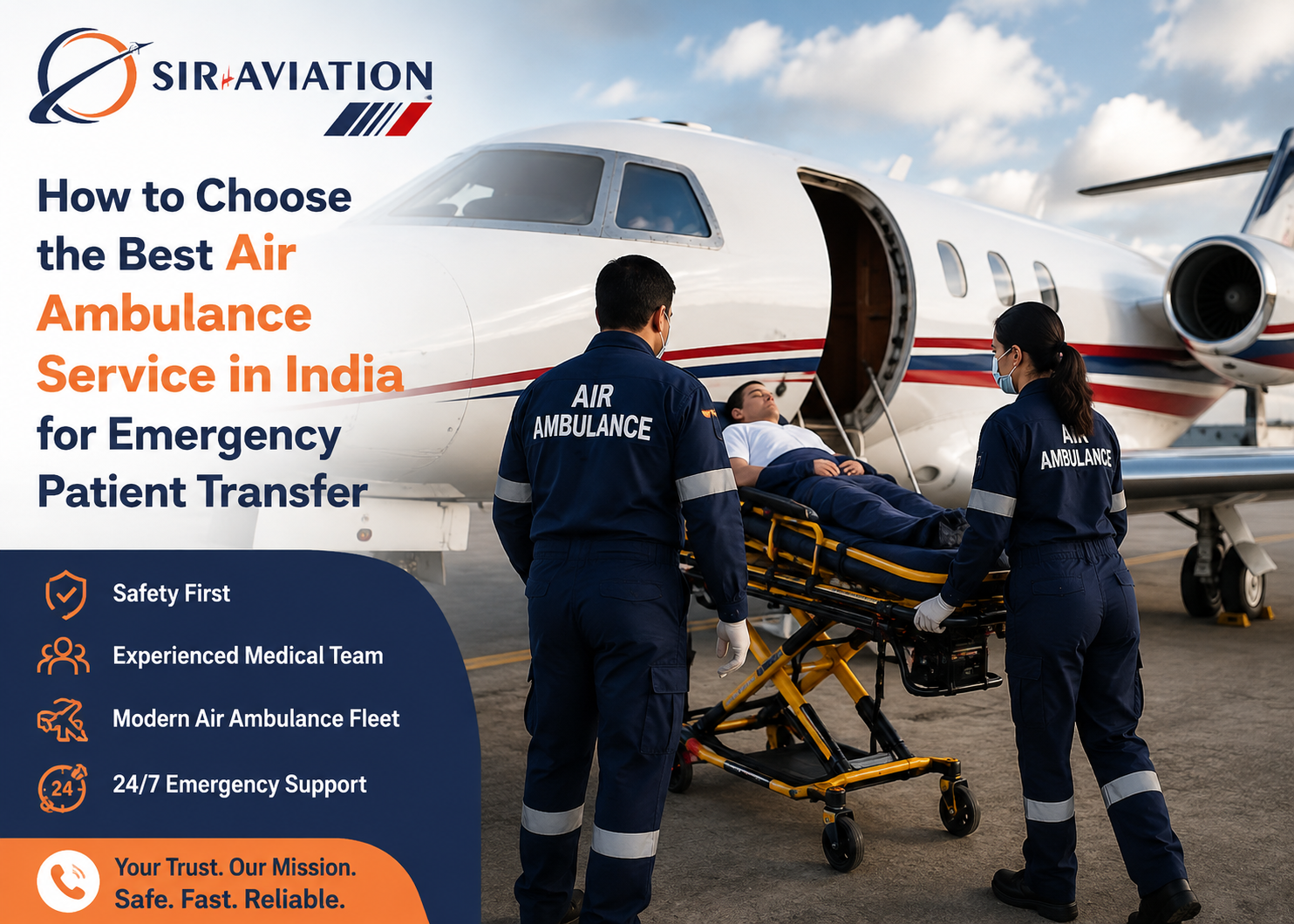
When a patient requires urgent medical transportation over a long distance, choosing the best air ambulance service in India can make a significant difference. Air ambulances help move critically ill or injured patients between cities when road transportation may take too long or when specialist treatment is available at a distant hospital. However, not every service offers the same aircraft, medical support, operational standards, or patient-care capabilities. Families and hospitals should evaluate several factors before selecting an aviation provider.
For SIR Aviation, patient movement involves more than arranging an aircraft. A successful transfer requires careful coordination between aviation professionals, medical teams, hospitals, ground ambulances, and the patient’s family. The right service should combine aviation expertise with reliable medical coordination and a clear focus on patient safety.
Why Choosing the Right Air Ambulance Service Matters
Emergency patient transfers often involve limited time and considerable pressure. A patient may need to travel from a smaller city to a metropolitan hospital for specialised treatment, or a hospital may need to transfer a patient to another facility with advanced clinical capabilities.
Air transportation can reduce travel time considerably compared with long-distance road journeys. Yet speed alone should not determine the choice of an air ambulance provider.
The aircraft must be suitable for the patient’s condition. Medical equipment must match the patient’s requirements. Qualified medical personnel should be available when necessary, and the aviation operator must follow appropriate safety and operational procedures.
A poorly planned transfer can create unnecessary complications. A well-coordinated transfer can provide a smoother transition from one medical facility to another.
Therefore, families should consider the complete patient-transfer arrangement rather than simply selecting the provider offering the lowest quoted price.
1. Check the Company’s Aviation Experience
The first factor to consider is the provider’s experience in aviation operations.
Air ambulance transportation involves aircraft scheduling, route planning, airport coordination, permissions, weather considerations, landing arrangements, and ground transportation. These responsibilities require specialised aviation knowledge.
Ask how long the company has been involved in aviation services and how it manages emergency patient movements. A provider with established operational experience can coordinate multiple elements of a transfer more efficiently.
It is also useful to ask whether the company has experience operating transfers between the specific cities involved. India has a large geographical area, and airport availability, flight routes, operating hours, and local logistics can vary significantly.
SIR Aviation focuses on aviation coordination and charter solutions, allowing patient-transfer arrangements to be planned around the operational requirements of each journey.
2. Evaluate the Aircraft Available for Patient Transfer
Aircraft selection is another important consideration.
Different aircraft have different cabin dimensions, cruising capabilities, range, airport requirements, and medical-support possibilities. The aircraft selected for a patient should accommodate the medical equipment and personnel required during the journey.
Before confirming a transfer, ask:
- What type of aircraft will be used?
- Can the aircraft accommodate the patient comfortably?
- Is there adequate space for medical personnel and equipment?
- Can the aircraft operate from the required airports?
- Is the aircraft suitable for the proposed route?
- What arrangements exist for stretcher transportation?
A patient requiring intensive monitoring may have different transportation requirements from a patient who is medically stable.
The provider should therefore assess the patient’s condition and transfer requirements before confirming the aircraft.
3. Ask About Medical Support During the Flight
An air ambulance is not simply an aircraft carrying a patient. For patients who require medical assistance during transportation, appropriate clinical support can be essential.
Ask the service provider whether trained medical professionals are available for the transfer and whether the medical team has experience with the patient’s particular condition.
Depending on the patient’s needs, medical support may include doctors, nurses, paramedics, or other qualified personnel.
The medical team may also need to monitor vital signs and manage equipment during the flight. Patients with critical conditions can require continuous supervision throughout the journey.
Families should provide accurate medical information to the service provider before the transfer. This allows the provider and medical team to determine the appropriate level of support.
4. Confirm the Medical Equipment Available
Medical equipment is one of the most important components of an emergency patient transfer.
The equipment required depends on the patient’s condition. Some transfers may require basic monitoring, while critically ill patients may require advanced equipment.
Potential requirements can include:
- Patient monitoring systems
- Oxygen support
- Ventilation equipment
- Infusion pumps
- Cardiac monitoring
- Emergency medication
- Defibrillation equipment
- Stretcher systems
- Other specialised medical equipment
Do not assume that every air ambulance carries identical equipment.
Ask the provider to confirm which equipment is available and whether additional equipment can be arranged based on the patient’s medical needs.
The treating hospital should communicate relevant clinical requirements clearly before the flight.
5. Examine Safety and Operational Standards
Safety should remain a central consideration when selecting an air ambulance provider.
The aviation operator should maintain appropriate aircraft standards, crew qualifications, maintenance practices, and operational procedures. Patients and families should feel comfortable asking questions about the aviation arrangements.
Important questions include:
- Who operates the aircraft?
- Is the aircraft properly maintained?
- Are qualified flight crew members assigned?
- What procedures are followed for emergency operations?
- How are weather-related risks handled?
- What happens if the planned airport becomes unavailable?
Professional aviation operations require contingency planning. Weather conditions, airport restrictions, technical issues, and other operational factors can affect flight arrangements.
A dependable provider should communicate such issues clearly instead of making unrealistic promises about flight schedules.
6. Consider Airport-to-Hospital Coordination
A patient’s journey does not begin or end at the airport.
Ground transportation plays a critical role in an air ambulance transfer. The patient may need to travel from the originating hospital to the airport and from the destination airport to the receiving hospital.
This requires coordination between aircraft operators, hospitals, and ground ambulance providers.
Ask whether the service provider can coordinate:
Hospital → Ground Ambulance → Airport → Aircraft → Destination Airport → Ground Ambulance → Receiving Hospital
A coordinated transfer can reduce unnecessary waiting periods and make the overall journey easier for the patient and family.
SIR Aviation can coordinate aviation requirements alongside the broader movement plan, helping ensure that different stages of the journey are addressed before departure.
7. Check Whether the Provider Can Handle Domestic Routes
India’s geography creates unique challenges for emergency patient transportation.
A patient may need to travel between cities such as Delhi, Mumbai, Bengaluru, Hyderabad, Chennai, Kolkata, Ahmedabad, Jaipur, Lucknow, Guwahati, or other locations.
Not every aircraft can operate from every airport under identical conditions. Airport infrastructure, runway specifications, operating hours, and aircraft requirements can influence the choice of route.
A capable provider should evaluate the complete route before confirming the transfer.
For longer journeys, the provider may also need to consider aircraft range, refuelling requirements, crew arrangements, and airport availability.
8. Look for Clear Communication
During an emergency, families need clear information.
A service provider should explain the proposed arrangements without unnecessary confusion. The family should know what is included, what information the medical team needs, what documents are required, and how the transfer will proceed.
Clear communication is particularly important when several parties are involved.
The aviation company may coordinate with:
- The patient’s family
- Treating doctors
- Receiving hospital
- Ground ambulance provider
- Flight crew
- Medical team
- Airport authorities
- Other operational partners
A single communication gap can delay the transfer. This is why experienced coordination matters.
9. Compare Pricing Without Compromising Safety
Cost is naturally an important consideration for families arranging emergency transportation. However, price should not be the only deciding factor.
Air ambulance costs can vary depending on several factors, including:
- Aircraft type
- Flight distance
- Medical team requirements
- Medical equipment
- Airport charges
- Ground ambulance services
- Crew requirements
- Waiting time
- Route complexity
- Additional operational arrangements
A very low initial quotation may not include every component of the transfer.
Ask for a clear cost breakdown and confirm what the quoted amount covers. This helps prevent unexpected expenses later.
The best value does not necessarily mean the lowest price. It means receiving an appropriate combination of safety, medical support, aircraft capability, coordination, and operational reliability.
10. Verify the Provider’s Emergency Response Capability
Emergency transfers often require rapid coordination.
When contacting an air ambulance company, ask how quickly the team can assess the request and begin planning. The provider should collect essential information about the patient, route, hospital, medical condition, and required equipment.
A structured response process can help reduce delays.
Families should keep important medical information ready, including:
- Patient’s age
- Medical condition
- Current hospital
- Destination hospital
- Treating doctor’s contact details
- Current clinical status
- Required medical support
- Preferred transfer timing
- Contact information of the family representative
Providing accurate information allows the provider to assess the transfer more efficiently.
11. Check Hospital Coordination Experience
Hospital coordination can become complicated when a patient requires immediate admission at the destination.
The receiving hospital should be informed about the patient’s arrival and medical requirements. The transfer team may need to coordinate with the hospital’s emergency department, ICU, specialist department, or admission team.
Ask whether the air ambulance provider has experience coordinating hospital-to-hospital transfers.
A strong transfer plan should account for the patient’s condition from departure through arrival rather than focusing only on the flight itself.
12. Ask About Contingency Planning
Emergency aviation requires flexibility.
Flights can be affected by weather, airport restrictions, aircraft availability, or other operational factors. A professional provider should have alternative arrangements when circumstances change.
Ask what happens if:
- Weather prevents departure
- The destination airport becomes unavailable
- The aircraft develops a technical issue
- The receiving hospital changes its availability
- The patient’s condition changes before departure
The provider should communicate the available alternatives and explain how decisions will be made.
This type of preparation provides families with greater confidence during an already stressful situation.
13. Review the Company’s Reputation
Before selecting an air ambulance provider, research its professional reputation.
Look for information about its aviation experience, patient-transfer operations, communication standards, and service history. Hospitals and medical professionals can also provide valuable insights based on their previous coordination with aviation providers.
However, online reviews should not be the only basis for a decision.
Consider reputation alongside aircraft capability, medical coordination, operational experience, safety practices, and transparency.
14. Make Sure the Provider Understands the Patient’s Needs
Every patient transfer is different.
A stable patient travelling between two cities may have relatively straightforward requirements. A critically ill patient may require specialised equipment, continuous monitoring, and a medical team capable of managing potential complications.
The provider should ask relevant questions before confirming the service.
A responsible approach involves assessing the patient first and then determining the appropriate transportation arrangement.
Families should also avoid withholding medical information simply because they are concerned that it may increase the cost or complicate the booking. Accurate information helps the aviation and medical teams prepare properly.
Why SIR Aviation Can Be Considered for Patient Transfer Coordination
SIR Aviation provides aviation solutions with a focus on professional coordination and operational requirements. Emergency patient transportation requires multiple moving parts, and aviation expertise can help bring those elements together.
The focus should remain on selecting an aircraft suitable for the journey, coordinating the required flight arrangements, working with relevant ground transportation providers, and supporting communication between the parties involved.
For families and hospitals considering an air ambulance transfer, the decision should always reflect the patient’s medical needs, route requirements, aircraft suitability, and safety considerations.
Questions to Ask Before Booking an Air Ambulance
Before confirming the service, keep a short checklist ready:
- What aircraft will be used?
- Is the aircraft suitable for the patient’s condition?
- What medical equipment will be available?
- Who will accompany the patient?
- Can the service coordinate ground ambulances?
- What airports will be used?
- How long will the complete transfer take?
- What is included in the quoted cost?
- What contingency arrangements are available?
- Who will remain the primary contact during the transfer?
Getting clear answers to these questions can make the decision easier.
Final Thoughts
Choosing the best air ambulance service in India requires more than comparing prices or asking how quickly an aircraft can depart. Families and hospitals should assess aircraft suitability, medical support, equipment, aviation experience, safety standards, route planning, hospital coordination, ground transportation, pricing, and contingency arrangements.
Emergency patient transportation requires precise coordination because every stage of the journey matters. A reliable aviation provider should communicate clearly, assess the patient’s requirements carefully, and develop transportation arrangements around those needs.
SIR Aviation approaches air ambulance coordination with an emphasis on aviation expertise, operational planning, and dependable communication. When a patient needs urgent intercity transportation, making an informed choice can help create a safer and more organised transfer experience.
FAQs
How much does an air ambulance service cost in India?
The cost varies according to aircraft type, distance, medical team, equipment, airport charges, ground transportation, route requirements, and other operational factors. Request a detailed quotation that clearly states what the price includes.
Can an air ambulance transfer critically ill patients?
Yes, air ambulance transfers can be arranged for critically ill patients when the patient's medical condition and transportation requirements have been appropriately assessed. The required medical team and equipment depend on the patient's condition.
Does an air ambulance service include ground transportation?
Ground ambulance arrangements may form part of the overall transfer plan, depending on the provider and service package. Confirm whether transportation from the hospital to the departure airport and from the destination airport to the receiving hospital is included.