
How Much Does a Helicopter Flower Dropping Service in India Cost?
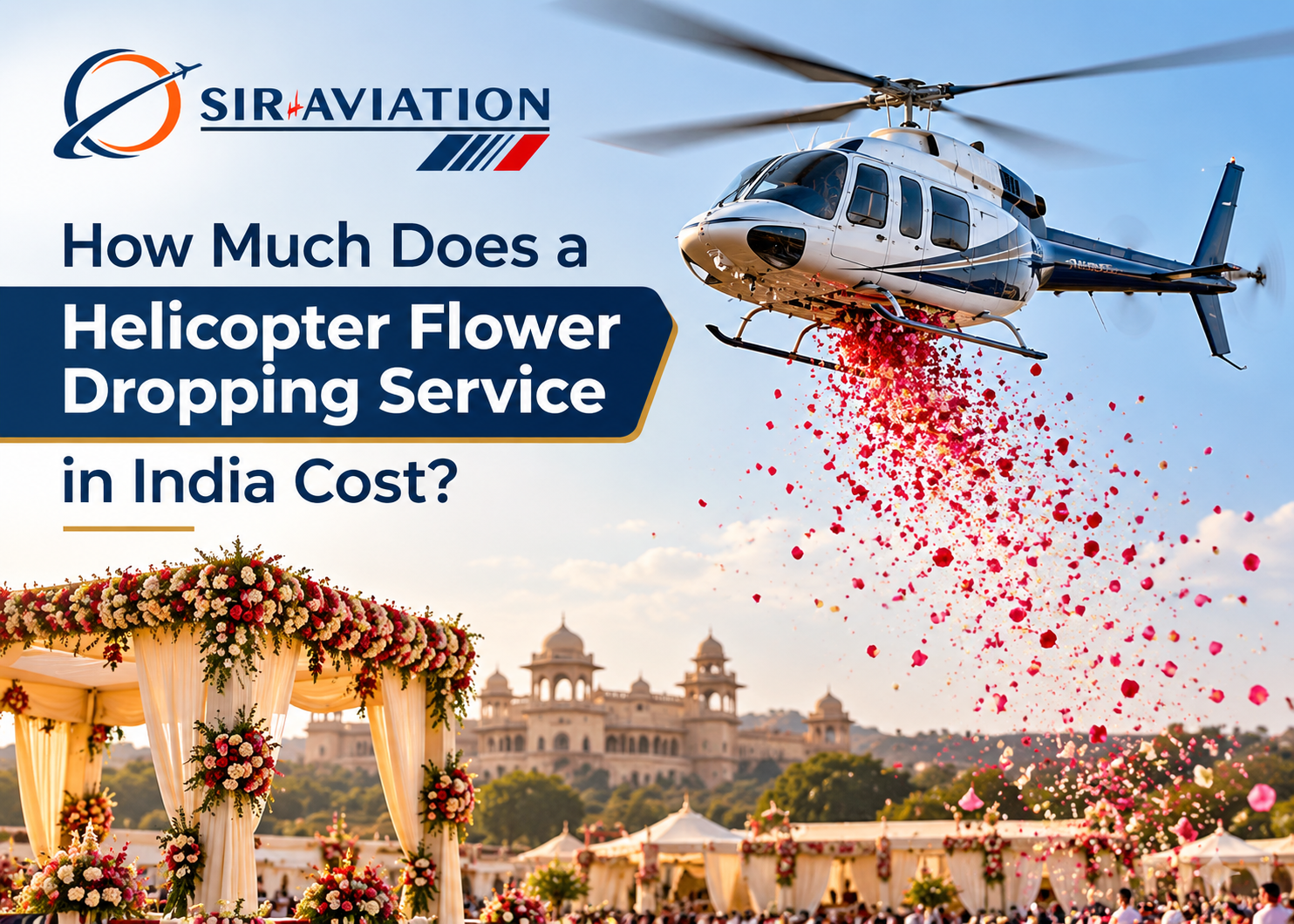
Helicopter flower dropping in India rarely carries one fixed nationwide price because the visible shower forms only one part of the aviation operation. A quotation can change with flying time, positioning, location, airspace, petals, permissions, timing, landing needs, and contingencies. Therefore, compare the operational scope behind each figure rather than only the headline amount.
What Should You Expect to Pay?
There is no reliable market-wide figure that applies to every event across India. Providers generally prepare customised quotations after checking where the helicopter starts, how far it must fly, how long it will operate around the venue, what route is feasible, and what operational coordination the event requires.
An advertised starting amount may not represent the final payable amount. It can assume a particular aircraft, base, duration, event radius, schedule, or inclusion list. An indicative estimate supports early planning, while a customised quotation reflects a specific event. The final amount can change if scope, timing, route, conditions, or charges change.
For that reason, anyone seeking a helicopter flower dropping service in India should request a written breakdown of what the quoted amount actually covers.
For budgeting, treat an early estimate as provisional until the operator confirms aircraft availability, routing, movement, event timing, release planning, and applicable operational requirements. A comparison should therefore rely on matched scope and written inclusions.
The Main Components Behind the Quotation
A short flower shower can require much more aviation activity than the audience sees. Consequently, the quotation normally reflects the entire operation.
Common pricing influences include:
- aircraft flying time for the planned operation;
- positioning or ferry flying to reach the event area;
- return movement after the event;
- the helicopter’s operating base;
- event location and routing;
- time required for the planned aerial passes;
- waiting or standby requirements;
- landing, staging, parking, or handling needs where relevant;
- crew and operational logistics;
- preparation and carriage of permitted flower petals;
- aviation coordination and applicable approvals;
- schedule changes or additional flying;
- taxes and other stated charges, where applicable.
Providers may combine several items into one package or present them separately. Therefore, two quotations with similar totals can still cover different operational scopes.
Why Flying Time Matters So Much
Helicopter operations are strongly influenced by aircraft movement. The total flying requirement may include departure from the operating base, travel to the event area, one or more approved passes, movement to a landing or refuelling point if required, and the return sector.
Visible Event Time Versus Total Aircraft Time
The flower shower may last only briefly. However, the helicopter could spend considerably longer travelling between its base and the venue, so visible duration alone can misrepresent the operator’s cost.
For example, an event near an existing operating base may require less positioning than a similar event far from the aircraft’s starting point. Meanwhile, a distant venue can create additional flying even if the flower-dropping pattern over the event remains identical.
Positioning and Ferry Flying
Positioning, often called ferry flying, covers aircraft movement needed to place the helicopter for the operation or return it afterwards. The aircraft may travel from another city, airport, heliport, or operating location before reaching the event area.
This factor can materially influence a quotation because aircraft utilisation occurs during those sectors as well. Consequently, organisers should ask whether the quoted flying time includes positioning and the return movement, rather than assuming that both sit inside a package price.
How the Operating Base Changes the Economics
The same event location can produce different quotations if different aircraft start from different bases. A helicopter already positioned reasonably close to the venue may require less ferry flying than one that must travel a substantial distance before reaching the event.
The operating base also affects fuel planning, crew duty considerations, airport or heliport use, parking, and staging. Not every factor creates a separate line item, but each can influence the overall price.
When comparing offers, ask which operating base and aircraft the quotation assumes. If the aircraft changes later, the movement plan and cost structure may also change.
Event Location Can Affect Both Price and Feasibility
Venue location influences more than distance. Airspace, nearby airports, urban density, restricted areas, terrain, available landing infrastructure, and local operating conditions can all affect how the flight is planned.
An event near controlled airspace or an aerodrome may require closer coordination with air traffic services. Current Indian aeronautical information also shows that helicopter operations around major airports can follow specified routes and ATC instructions, while certain military or restricted airspace operations can require additional clearances.
Remote sites may increase positioning distance, reduce support options, or complicate staging. Dense urban venues can add route, safety, crowd, and airspace constraints.
Therefore, a location cannot be treated as approved merely because another event in the same city previously used a helicopter.
Duration, Flight Pattern, and Number of Passes
A flower-dropping request usually needs a defined operating concept: where the helicopter will approach, the area to be covered, how many passes are requested, and how the release will fit within the permitted flight plan and local conditions.
More passes can increase operating time. However, the commercial effect depends on routing, holding, air traffic requirements, staging distance, and operational acceptability.
The requested pattern also matters. A narrow ceremonial point, a longer procession route, and a broad venue may require different flight planning. Wind can alter petal dispersion, so a plan that looks simple on a map may need adjustment close to the event.
Describe the intended coverage area clearly. A precise brief lets the operator assess time, route, release planning, and feasibility more accurately.
Flower Quantity, Payload, and Release Planning
Petal quantity cannot be increased without limit. Every helicopter operates within approved weight and performance constraints, while the operator must also account for fuel, crew, equipment, operating conditions, and the intended flight profile.
Suitable planning should address:
- the type of floral material proposed;
- approximate quantity and weight;
- safe loading within aircraft limitations;
- the approved release method;
- timing and location of release;
- expected ground coverage;
- wind-related dispersion;
- people, property, and sensitive areas below.
Indian aircraft rules specifically address dropping items from aircraft and contain an exception relating to separate flower petals under stated conditions. Consequently, organisers should leave the aviation release method and regulatory assessment to the operator rather than assume that any material can be carried and dropped.
Permissions and Operational Coordination
There is no single approval that can be assumed to cover every flower-dropping operation. The required coordination can vary with the helicopter operation, route, airspace, nearby aerodromes, event type, landing plan, security conditions, and local restrictions.
Flight planning is also a formal aviation function. India’s current aeronautical information states that intended flights in Indian airspace generally require information to be submitted to the relevant air traffic service unit through the prescribed flight-planning process.
Where a landing area is involved, the Ministry of Civil Aviation’s HeliSewa system allows eligible air operators to submit operation requests for helicopter landing sites. Its published information also distinguishes landowner permission from district administration intimation in the circumstances covered by that system.
Customers should ask who will coordinate aviation permissions, landing arrangements, authority communication, and event-side requirements, and which responsibilities remain with the organiser.
Does the Helicopter Need to Land at the Venue?
Not necessarily. A helicopter may be able to perform an aerial pass over or near an event area without landing at the venue, provided the planned operation, routing, release, airspace, and safety requirements support that arrangement.
However, some operations may still need a suitable landing or staging point for operational reasons. Refuelling, crew requirements, aircraft positioning, airport use, loading arrangements, or the wider flight plan can make a landing facility relevant even when the helicopter does not touch down inside the event site.
If a temporary or non-scheduled landing location forms part of the plan, ownership consent, local communication, site suitability, and operator procedures can become relevant. Therefore, organisers should avoid assuming that a clear patch of ground automatically qualifies as an operational landing area.
Weather, Waiting Time, and Schedule Changes
Weather can alter the operation even after commercial terms have been agreed. Visibility, wind, thunderstorms, local conditions, air traffic restrictions, aircraft availability, and other aviation factors can affect timing or execution.
Waiting time can also influence charges, especially if delays affect flying limitations, fuel planning, airport availability, airspace coordination, or another scheduled sector.
Before confirmation, check the written terms for:
- weather-related cancellation or postponement;
- rescheduling conditions;
- event-time changes;
- waiting or standby treatment;
- additional flying requested on the day;
- refund or credit arrangements;
- aircraft substitution, where relevant;
- operational cancellation rights.
A booking and payment do not remove aviation constraints. The commercial terms should therefore explain what happens when conditions prevent the originally planned flight.
Information to Provide Before Requesting a Quote
A detailed initial brief helps the operator assess feasibility and prepare the proposal. Provide:
- event date and preferred operating time;
- exact venue location;
- type of event;
- expected duration of the flower-dropping segment;
- requested number of passes, if already planned;
- approximate petal requirement, if known;
- desired coverage area;
- nearby airport, heliport, or landing information, if known;
- schedule flexibility;
- organiser’s contact details;
- known venue, security, or authority restrictions.
Supplying these details does not secure aviation approval. It simply gives the provider a stronger basis for evaluating aircraft movement, operational feasibility, and quotation scope.
How to Compare Two Quotations Properly
A lower headline amount may exclude items another quotation includes. Consequently, compare operational assumptions line by line.
Ask each provider to clarify:
- the total flying time included;
- the operating base used for the calculation;
- whether ferry positioning is included;
- whether the return sector is included;
- the aircraft type assumed;
- the number of planned passes;
- whether flower petals are included;
- who handles applicable aviation coordination;
- whether airport, landing, parking, or ground handling charges are included where relevant;
- whether taxes are included;
- the treatment of waiting time;
- weather, postponement, and rescheduling terms;
- costs that may arise outside the stated scope.
Also check quotation validity and the assumptions attached to the event timing. A price calculated around one aircraft position or schedule may change if the aircraft must later operate from another base.
Potential Costs Outside a Basic Quote
Some quotations group many components; others show separate charges. Therefore, do not assume every expense sits inside the first figure.
Depending on the operation, items requiring clarification may include airport or heliport use, landing or parking, ground handling, additional positioning, extra flying, extended waiting, schedule changes, petal supply, local site arrangements, taxes, or other agreed operational costs.
The safest comparison uses the same scope for every bidder. If one provider quotes only the aerial operation while another includes positioning, return flying, petals, and coordination, the two totals do not represent equivalent offers.
Planning Before and After Confirmation
Early planning gives the operator more time to assess aircraft availability, routing, landing needs, airspace, and event coordination.
Before booking, confirm scope, responsibilities, schedule window, contingency terms, and contacts. After confirmation, keep the event team aligned with timing, venue instructions, access controls, loading, and operational updates.
If the programme changes, communicate the change promptly. A shift in event timing can affect far more than audience scheduling because the aircraft may operate within a larger sequence of movements and constraints.
Conclusion
The useful question is not simply how much a flower-dropping flight costs, but what aircraft movement and operational scope sit behind the figure. Compare flying time, positioning, return sectors, petals, permissions, landing needs, taxes, timing conditions, and contingency terms on the same basis. A clear quotation with defined assumptions gives organisers a stronger basis for budgeting than an isolated headline amount.
Frequently Asked Questions
Is there usually a minimum booking duration?
Minimum commercial terms can vary by operator, aircraft, operating base, and assignment. Some quotations may reflect minimum aircraft utilisation even when the visible flower shower lasts only a short time. Ask how much flying time the proposal includes and whether any minimum utilisation condition affects the total.
What are positioning charges in a helicopter quotation?
Positioning covers aircraft movement needed to reach the area from which the event operation can begin and, where applicable, to return afterwards. Because the helicopter may travel well beyond the venue itself, ferry flying can materially affect the total amount even when the ceremonial pass is brief.
Are flower petals normally included in the quoted amount?
Quotation structures differ. One provider may include petal supply and preparation, while another may quote only the aviation operation. Confirm who supplies the petals, what type and quantity the operator will accept, how loading will be handled, and whether any related cost appears inside or outside the stated figure.
Who handles permissions for the flight?
The aviation operator normally manages operator-side flight planning and the permissions or coordination that fall within its operational responsibilities. However, organisers may still need to support venue access, landowner consent, event permissions, security coordination, or local requirements. The quotation should clearly allocate responsibilities instead of leaving them implied.
Can the venue location make the service more expensive?
Yes. Distance from the operating base can increase aircraft movement, while controlled airspace, nearby aerodromes, remote access, staging limitations, or other operational conditions can affect planning. Location can also influence feasibility, so two events requiring similar flower coverage may still produce different quotations.
What happens if weather prevents the planned flight?
The outcome depends on the agreed commercial terms and the operator's operational decision. Before booking, check how the contract treats weather cancellation, postponement, rescheduling, credits, refunds, and additional costs. Event organisers should also maintain timing flexibility because aviation conditions can change close to the planned operation.
How early should an organiser request a quotation?
Requesting a quotation early gives more time to assess aircraft availability, positioning, routing, landing needs, airspace, event restrictions, and coordination requirements. Lead time varies by operation, so organisers should avoid assuming a fixed approval period and should provide complete event details as soon as the plan becomes reasonably firm.
Must the helicopter land at the event venue?
No. A flower-dropping operation may be planned without a landing at the venue if the approved route and operational setup support it. However, the wider flight may still require a landing or staging point elsewhere for fuel, loading, crew, positioning, or other operational reasons.
What should a customer check before accepting a quotation?
Check the included flying time, operating base, positioning, return sector, aircraft assumption, petals, permissions, relevant airport or ground charges, taxes, standby treatment, and weather terms. Also ask what could trigger a revised price. Comparing identical scope prevents a low headline amount from hiding important exclusions.