
Air Ambulance Vs. Ground Ambulance in India: When to Choose Which for Safe Medical Transfer
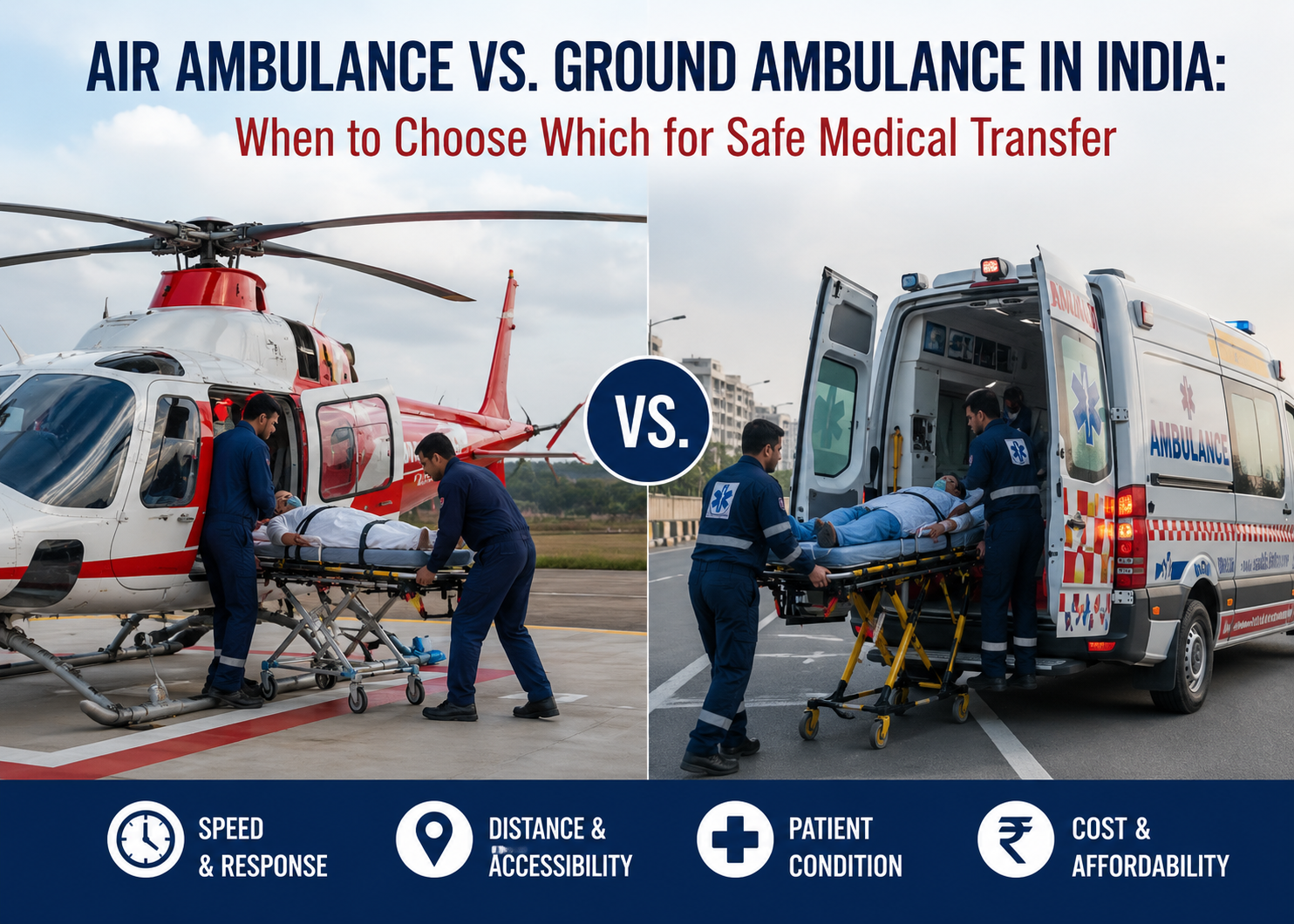
Medical emergencies rarely come with warning. In such critical moments, the speed, safety, and efficiency of patient transport can directly impact survival and recovery. Choosing between an air ambulance and a ground ambulance is not just a logistical decision—it is often a life-saving one.
India’s diverse geography, traffic congestion, and varying healthcare accessibility make this choice even more important. From crowded urban centers to remote rural regions, each mode of transport serves a distinct purpose. At SIR Aviation, the focus is always on ensuring that patients receive the right care, at the right time, through the most suitable medical transfer option.
What Is an Air Ambulance?
An air ambulance is a specially equipped aircraft—either a helicopter or a fixed-wing plane—designed to transport critically ill or injured patients. These flying intensive care units are fitted with advanced medical equipment such as ventilators, cardiac monitors, infusion pumps, and emergency medication.
Highly trained medical teams, including doctors, paramedics, and critical care specialists, accompany the patient throughout the journey. Air ambulances are often used for long-distance transfers, intercity or interstate emergencies, and situations where time is a critical factor.
What Is a Ground Ambulance?
A ground ambulance is a road-based medical transport vehicle that ranges from basic life support (BLS) units to advanced life support (ALS) systems. These ambulances are widely available across cities and towns in India and are typically the first responders in emergency situations.
Ground ambulances are equipped to handle a variety of medical conditions, from minor injuries to critical emergencies, depending on the level of care required.
Key Differences Between Air and Ground Ambulance
1. Speed and Response Time
Air ambulances are significantly faster, especially over long distances. They can bypass traffic congestion and geographical barriers, making them ideal for time-sensitive emergencies such as cardiac arrest, stroke, or organ transport.
Ground ambulances, while essential, are often delayed by traffic, road conditions, and distance. In metropolitan cities like Delhi or Mumbai, even a short journey can take considerable time during peak hours.
2. Coverage and Accessibility
Air ambulances can reach remote or inaccessible areas such as mountainous regions, islands, or disaster zones where road connectivity is limited or non-existent.
Ground ambulances are more practical for short distances and urban environments where hospitals are easily accessible.
3. Medical Facilities Onboard
Air ambulances function as flying ICUs, offering critical care capabilities comparable to hospital settings. They are suitable for patients requiring constant monitoring and advanced life support.
Ground ambulances vary in capability. While ALS ambulances provide advanced care, not all ground units are equipped for highly critical cases.
4. Cost Consideration
Air ambulance services are significantly more expensive due to aircraft operation costs, medical equipment, and specialized personnel.
Ground ambulances are more cost-effective and accessible for the majority of patients, especially for short-distance transfers.
5. Distance Suitability
Air ambulances are ideal for long-distance transfers, particularly when a patient needs to be moved between cities or states quickly.
Ground ambulances are best suited for short distances, such as transferring patients within a city or to nearby hospitals.
When to Choose an Air Ambulance in India
Choosing an Air Ambulance in India becomes essential in specific situations where time, distance, and medical urgency intersect.
Critical Medical Emergencies
Conditions like severe trauma, cardiac arrest, stroke, or organ failure demand immediate intervention. Air ambulances minimize travel time, increasing the chances of survival.
Long-Distance Transfers
When a patient needs to be moved from one city to another for specialized treatment, air ambulances provide the fastest and safest option.
Remote Location Rescue
In regions with poor road infrastructure—such as hilly terrains, rural interiors, or flood-affected areas—air ambulances ensure quick evacuation and access to advanced healthcare facilities.
Organ Transplant Logistics
Air ambulances play a vital role in transporting organs and transplant teams within tight timeframes, ensuring successful procedures.
Pandemic or Infectious Cases
During health crises, air ambulances equipped with isolation units help safely transport patients while minimizing the risk of infection spread.
When to Choose a Ground Ambulance
Ground ambulances remain the backbone of emergency medical services and are often the most practical choice in many scenarios.
Short-Distance Transfers
For moving patients within a city or to nearby healthcare facilities, ground ambulances are efficient and readily available.
Stable Medical Conditions
Patients who are stable and do not require intensive monitoring can be safely transported via ground ambulance.
Cost-Sensitive Situations
For families concerned about expenses, ground ambulances offer a more affordable option without compromising essential care.
Initial Emergency Response
Ground ambulances are typically the first responders at accident sites or medical emergencies, providing immediate care before further transfer if needed.
Factors to Consider Before Making a Choice
Patient’s Medical Condition
The severity of the patient’s condition is the most critical factor. Patients requiring continuous monitoring, ventilator support, or specialized care are better suited for air transport.
Distance and Time Sensitivity
If time is a crucial factor and the distance is significant, air ambulances are the preferred choice.
Availability of Medical Facilities
The need to reach a specialized hospital quickly can influence the decision toward air transport.
Budget Constraints
While safety is paramount, financial considerations cannot be ignored. Evaluating the cost-benefit ratio is essential.
Location and Accessibility
Remote or disaster-affected areas often necessitate air ambulance services due to limited road access.
Integrated Medical Transport: A Combined Approach
In many cases, the most effective solution is a combination of both air and ground ambulance services. This integrated approach ensures seamless patient transfer from the point of origin to the destination hospital.
For example, a ground ambulance may transport the patient from their home to the nearest airport, where an air ambulance takes over for long-distance travel. Upon arrival, another ground ambulance ensures safe transfer to the receiving hospital.
SIR Aviation specializes in such coordinated transfers, ensuring continuity of care at every stage.
Safety Standards and Medical Expertise
Safety is a non-negotiable aspect of medical transport. Air ambulances operated by experienced providers like SIR Aviation adhere to strict aviation and medical protocols.
Highly trained pilots, certified medical teams, and advanced life-support systems ensure that patients receive uninterrupted care throughout the journey.
Ground ambulances, when operated by professional services, also maintain high standards of patient care, hygiene, and emergency response readiness.
The Role of Technology in Medical Transport
Modern medical transport relies heavily on technology. Real-time tracking, telemedicine support, and advanced communication systems enable better coordination between medical teams.
Air ambulances are equipped with state-of-the-art navigation and monitoring systems, ensuring precision and safety even in challenging conditions.
Ground ambulances are increasingly adopting GPS tracking and digital health monitoring tools, improving response times and patient outcomes.
Challenges in India’s Medical Transport Landscape
Despite advancements, certain challenges persist:
- Traffic congestion in urban areas
- Limited awareness about air ambulance services
- High operational costs
- Infrastructure gaps in rural regions
Addressing these challenges requires collaboration between healthcare providers, aviation services, and government authorities.
Why SIR Aviation Stands Out
SIR Aviation has established itself as a trusted name in medical air transport by focusing on patient-centric services, safety, and efficiency.
Key strengths include:
- Rapid response and deployment
- Experienced medical and aviation teams
- Advanced ICU-equipped aircraft
- Seamless coordination with hospitals
- Nationwide and international coverage
Every mission is handled with precision, compassion, and a commitment to saving lives.
Final Thoughts
The choice between an air ambulance and a ground ambulance depends on multiple factors—medical urgency, distance, cost, and accessibility. Both play vital roles in India’s healthcare ecosystem, and neither replaces the other.
Air ambulances bring speed and advanced care to critical situations, while ground ambulances provide essential, accessible support for everyday emergencies. Knowing when to choose which can make a significant difference in patient outcomes.
In moments where every second counts, having a reliable partner like SIR Aviation ensures that patients receive the care they need, exactly when they need it.