
What Are Aeromedical Aviation Services and How Do They Work?
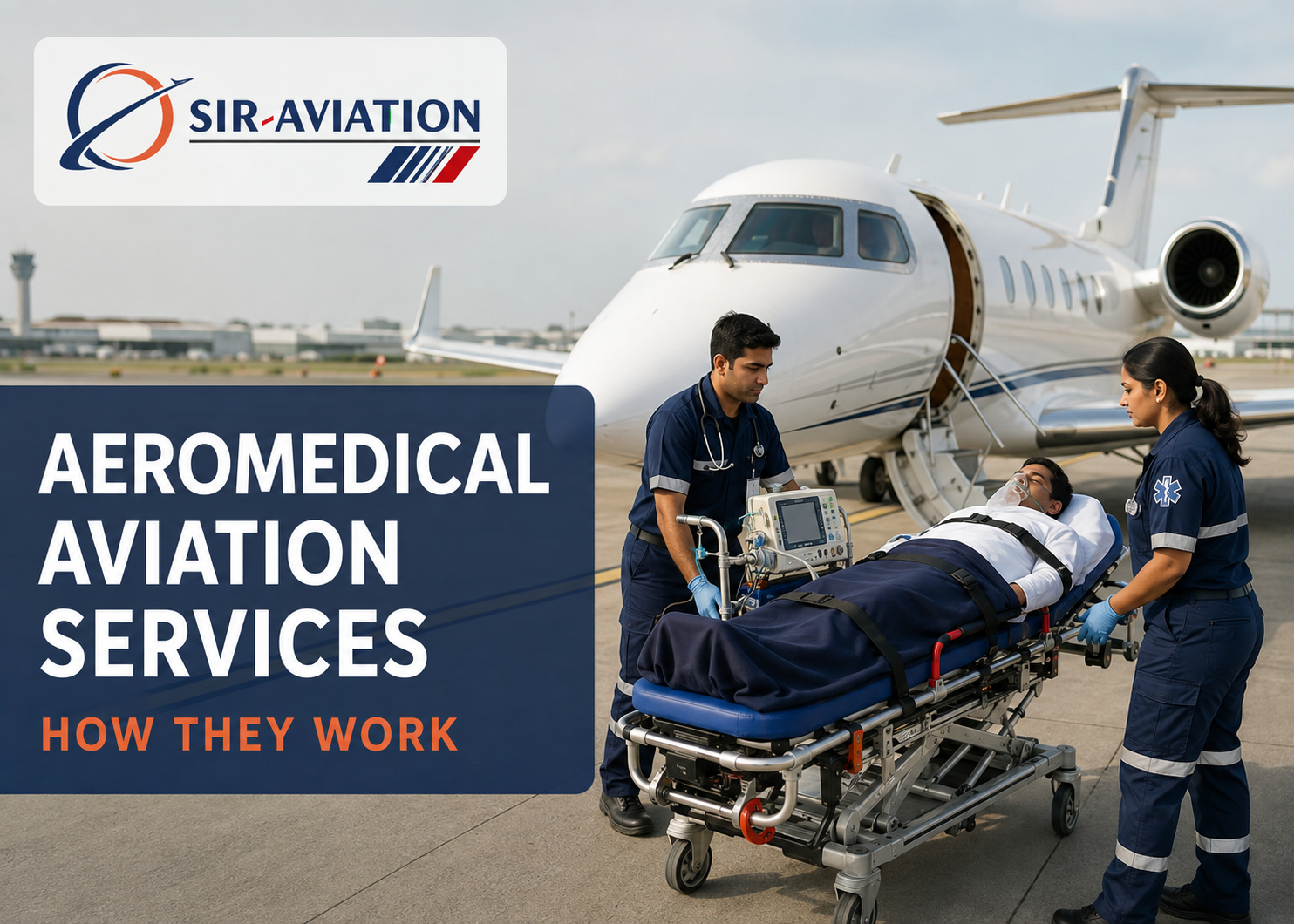
When a patient requires urgent treatment in another city or country, a conventional ambulance may be too slow or medically unsuitable. Aeromedical aviation services combine specialised medical care with air transportation to move patients safely between healthcare facilities. These services use medically equipped aircraft, trained flight crews and qualified healthcare professionals to maintain continuous care throughout the journey.
Aeromedical transportation is much more than placing a patient inside an aircraft. Every mission requires clinical evaluation, aircraft planning, medical equipment, airport coordination, regulatory compliance and communication between hospitals. The objective is to create a controlled medical environment in the air while reducing travel time and clinical risk.
SIR Aviation supports carefully coordinated aeromedical missions for patients, families, hospitals, healthcare organisations and assistance companies across India and international destinations.
What Are Aeromedical Aviation Services?
Aeromedical services involve transporting an ill, injured or medically vulnerable person by aircraft under the supervision of trained medical professionals. Depending on the patient’s condition, the mission may use a fixed-wing aircraft, helicopter or scheduled commercial flight with medical support.
The aircraft may carry equipment such as a stretcher, oxygen supply, ventilator, cardiac monitor, infusion pump, suction device, defibrillator and emergency medicines. The exact medical configuration depends on the patient’s diagnosis, current stability, destination and expected flight duration.
These services commonly support:
- Critically ill patient transfers
- Trauma and accident evacuations
- Cardiac and neurological cases
- Organ transplant coordination
- Neonatal and paediatric transfers
- Patients requiring ventilator support
- International medical repatriation
- Bed-to-bed hospital transfers
- Elderly or mobility-restricted travellers
- Medical escorts on commercial flights
Each mission is planned around the individual patient rather than a standard transport package.
Why Is Air Medical Transportation Required?
Medical emergencies can occur far from an appropriate healthcare facility. A patient may be in a rural area, another state, an island, an overseas location or a region with limited specialist treatment. Road transportation could take many hours and expose the patient to delays, vibration, traffic and prolonged discomfort.
Air transportation significantly shortens travel time over long distances. It can connect remote locations with tertiary hospitals, trauma centres, transplant units or specialised care facilities.
Aeromedical transport may also be arranged when a patient becomes ill while travelling. Families often want the person moved closer to home, where familiar doctors and relatives can participate in recovery. In other situations, the required treatment may only be available at a particular medical centre.
The decision to fly should always be based on clinical suitability. Faster transportation is valuable only when the patient can tolerate the aviation environment and receive suitable care throughout the transfer.
How Do Aeromedical Aviation Services Work?
A successful patient transfer follows a structured sequence. Medical and aviation teams must work together from the first enquiry until the receiving hospital accepts the patient.
1. Initial Medical Information Is Collected
The process begins when a family member, hospital, doctor, insurer or assistance company contacts the service provider. The coordination team requests essential information about the patient.
This may include:
- Diagnosis and recent clinical history
- Age, weight and mobility level
- Current hospital and destination
- Oxygen or ventilator requirements
- Vital signs and consciousness level
- Medications and ongoing treatment
- Infection status
- Recent surgery or trauma
- Treating doctor’s notes
- Preferred receiving hospital
Accurate information is essential because the aircraft, medical crew and equipment are selected according to the patient’s clinical needs.
2. A Medical Assessment Is Completed
A flight physician or qualified medical professional reviews the records and speaks with the treating team when necessary. The purpose is to determine whether the patient is fit for air transfer and what support will be required.
Some patients may need stabilisation before departure. For example, low oxygen levels, uncontrolled bleeding, severe pain or unstable blood pressure may require treatment before movement. The medical team may recommend a delay if immediate flying presents an unacceptable risk.
The assessment also considers how changes in cabin pressure could affect the patient. Reduced atmospheric pressure at altitude may influence oxygen delivery, trapped gases, respiratory function and certain postoperative conditions.
3. The Right Aircraft Is Selected
Aircraft selection depends on distance, airport access, patient condition, medical equipment and the number of accompanying people.
Fixed-wing air ambulances are commonly used for long-distance domestic and international missions. Depending on the aircraft, they may offer space for a stretcher, medical crew, equipment and limited companions.
Helicopters can be valuable for short, time-sensitive transfers or locations with difficult road access. Their range, cabin space and weather limitations differ from those of fixed-wing aircraft.
Aircraft availability alone should not determine the choice. Runway length, fuel stops, weather, airport operating hours, cabin dimensions and loading access must also be checked.
4. The Medical Team Is Assigned
The medical crew is chosen according to the patient’s condition. A stable patient may travel with a trained flight nurse or paramedic. A critical patient may require a doctor and critical care nurse.
Neonatal transfers may involve specialists experienced in caring for premature babies and critically ill infants. Cardiac, respiratory and trauma cases may require professionals with relevant intensive care experience.
Aeromedical personnel must be able to work effectively in a restricted cabin. They must monitor the patient, operate equipment, manage unexpected deterioration and communicate with the pilots without disrupting flight safety.
5. The Aircraft Is Medically Configured
Before departure, the team installs and checks all required medical equipment. Every item must be properly secured because loose equipment can become hazardous during turbulence, take-off or landing.
Power supply, battery endurance and oxygen capacity are calculated for the entire mission, including ground delays and possible diversions. Backup supplies are carried when clinically necessary.
Equipment may include:
- Portable ventilators
- Multiparameter monitors
- Defibrillators
- Oxygen cylinders
- Syringe and infusion pumps
- Suction systems
- Airway management devices
- Immobilisation equipment
- Emergency medication kits
- Neonatal transport incubators
The medical configuration is checked before the patient reaches the aircraft.
What Is a Bed-to-Bed Air Ambulance Transfer?
A bed-to-bed transfer covers the patient’s complete movement from the current hospital to the receiving facility. It usually includes a ground ambulance at both ends, airport handling, air transportation and hospital handover.
The first ground ambulance collects the patient from the sending hospital and takes them to the departure airport. The patient is then transferred into the aircraft using an approved loading method.
After landing, another ambulance moves the patient from the destination airport to the receiving hospital. The medical team remains responsible for care throughout these stages, subject to the agreed mission plan.
This model reduces gaps between different transport providers and gives families a single coordination point.
What Happens During the Flight?
Once the patient is safely positioned, the medical crew connects monitoring devices, checks oxygen delivery and confirms that intravenous lines, drains and tubes remain secure.
During flight, the team monitors factors such as:
- Heart rate
- Blood pressure
- Oxygen saturation
- Breathing pattern
- Body temperature
- Level of consciousness
- Ventilator performance
- Medication response
Cabin noise, vibration, limited space and altitude-related pressure changes make airborne care different from hospital care. Medical staff must anticipate possible changes rather than wait for complications to develop.
The pilot and medical team remain in communication. If the patient deteriorates significantly, the crew may consider a diversion to a suitable airport. Such decisions balance medical urgency, available airports, fuel, weather and operational safety.
How Does Cabin Altitude Affect a Patient?
Although many aircraft cabins are pressurised, cabin pressure is normally lower than pressure at sea level. This can reduce the amount of oxygen available to the body. Healthy travellers usually tolerate the change, but patients with respiratory or cardiac conditions may require additional oxygen.
Gas inside the body can expand as pressure decreases. This matters for patients with trapped air following surgery, chest injury or certain medical procedures. Clinical teams assess these risks before confirming fitness to fly.
Dehydration, fatigue, immobility and temperature changes may also affect some patients. The medical plan should account for these factors, particularly during longer missions or flights involving several sectors.
What Is a Commercial Medical Escort?
Not every patient requires a dedicated air ambulance. Stable patients who can travel safely on a scheduled airline may use a commercial medical escort.
A doctor, nurse or paramedic accompanies the patient through the airport and during the flight. Depending on airline permission and clinical need, arrangements may include wheelchair support, supplementary oxygen, priority boarding or a stretcher installation.
Commercial escort services can be suitable for patients who need supervision but do not require intensive care. They are often more economical than chartering an entire aircraft, especially on international routes.
Airline approval is mandatory. Medical forms, equipment permissions, oxygen requirements and seating arrangements must be confirmed before travel.
Who Can Benefit From Aeromedical Transportation?
These services may be suitable for several patient groups, provided a medical assessment supports the transfer.
Critically Ill Patients
Patients receiving intensive care may need transfer to a hospital offering specialised surgery, advanced diagnostics or a higher level of critical care.
Accident and Trauma Patients
A road accident, industrial incident or serious injury in a remote location may require rapid transportation to a trauma centre.
Cardiac and Stroke Patients
Time is an important factor in many cardiac and neurological conditions. Air transfer may help connect the patient with an appropriate specialist facility when local resources are limited.
Neonatal and Paediatric Patients
Newborns and children require specialised equipment, medication calculations and temperature control. A trained paediatric or neonatal team may be assigned.
International Travellers
A traveller who becomes ill overseas may need medical repatriation to their home country. The mission may involve diplomatic permissions, immigration requirements and coordination across different healthcare systems.
Patients With Limited Mobility
A person recovering from surgery or living with a disabling condition may be unable to manage airport procedures independently. A medical escort can provide clinical supervision and mobility assistance.
What Factors Affect the Cost?
The cost of an aeromedical mission varies because every case has different operational and clinical requirements. Providers normally prepare a quotation after reviewing the medical information and route.
Major cost factors include:
- Flight distance
- Aircraft type
- Aircraft positioning
- Number of flight sectors
- Airport landing and handling fees
- Medical crew composition
- Equipment and oxygen requirements
- Ground ambulance arrangements
- International permits
- Overnight crew expenses
- Patient loading needs
- Urgency and aircraft availability
A low quotation should be examined carefully. Families should confirm which services are included, whether ground ambulances are covered and whether additional charges could apply after departure.
How Should You Select a Service Provider?
Choosing a provider requires more than comparing aircraft prices. Families and hospitals should assess both aviation capability and clinical coordination.
Ask the provider about:
- Aircraft certification and operational permissions
- Experience with similar medical cases
- Medical crew qualifications
- Equipment available aboard the aircraft
- Clinical review procedures
- Insurance coverage
- Ground ambulance coordination
- International mission experience
- Communication during the transfer
- Total quoted inclusions and exclusions
- Emergency or diversion procedures
- Patient data confidentiality
In India, aircraft operations and permissions must comply with applicable requirements issued by the Directorate General of Civil Aviation. International missions may also require clearances from authorities in the departure, transit and destination countries.
Why Coordination Matters as Much as Flight Time
The aircraft may complete the airborne sector quickly, but poor ground coordination can cause avoidable delays. A receiving hospital bed must be confirmed, ambulances must arrive at the correct time and patient documents must travel with the medical team.
Weather, airport slots, crew duty limits, permits and aircraft positioning can affect departure time. Clear communication helps families prepare for these variables without receiving unrealistic promises.
The World Health Organization’s medical evacuation framework also emphasises planning, coordination and safe execution as central elements of a medical evacuation.
The Role of SIR Aviation
SIR Aviation brings medical and aviation coordination together for domestic and international patient transfers. Each request begins with a review of the route, patient condition, hospital requirements and operational possibilities.
The team can coordinate suitable aircraft options, medical personnel, onboard equipment, airport arrangements and ground transportation based on mission needs. Families receive a clear point of contact throughout the process.
SIR Aviation recognises that medical transfers are emotionally demanding. Communication is therefore kept practical, respectful and transparent. The focus remains on patient safety, clinical continuity and efficient movement between healthcare facilities.
Final Thoughts
Aeromedical transportation connects patients with the care they need when distance, time or physical condition makes ordinary travel unsuitable. Its effectiveness depends on careful clinical assessment, appropriate aircraft selection, trained personnel and precise coordination at every stage.
A well-planned mission provides far more than a fast flight. It creates a continuous chain of care from the sending hospital to the receiving medical team. For families facing a difficult situation, choosing an experienced aviation partner can make the transfer safer, clearer and more manageable.
FAQs
Are aeromedical aviation services only used for emergencies?
No. Aeromedical aviation services handle emergency evacuations as well as planned patient transfers. They may be arranged for specialist treatment, rehabilitation, medical repatriation, postoperative travel, neonatal care or movement closer to family. Every patient must be assessed to determine the safest and most suitable transport option.
What medical equipment is available on an air ambulance?
Equipment varies according to the patient’s condition. An air ambulance may carry oxygen, a ventilator, cardiac monitor, defibrillator, infusion pumps, suction equipment, emergency medicines and airway devices. Neonatal missions may require an incubator and specialised monitoring systems. All equipment must be secured and checked before departure.
How quickly can aeromedical aviation services be arranged?
Timing depends on aircraft availability, medical clearance, airport permissions, weather, crew readiness and ground ambulance coordination. Domestic missions may sometimes be organised within several hours, while international transfers can require more time for permits and immigration formalities. A reliable provider confirms realistic timing after reviewing the complete case.